

The Bitcoin network is becoming more powerful as cryptocurrency prices climb in 2021. As more individuals and organizations adopt Bitcoin and decentralized apps become more widely available, a growing number of people...

Source: Adobe Stock
With the rise of cryptocurrency in 2021, Bitcoin's legacy gets stronger by the day. As institutions continue to invest in Bitcoin and decentralized apps become more widely available, an increasing number of individuals want to understand how these new technologies work. If an inquisitive crypto user stumbles across mining, he or she will almost certainly come across the terms Proof-of-Work (PoW) and Proof-of-Stake (PoS) (PoS).
To obtain a clearer perspective of cryptocurrencies, let's look at how this consensus process was initially came established.
A Brief History of Proof-of-Work
Mining and Proof-of-Work
Mining and Proof-of-Work have become synonymous in the crypto world. It's easy to see why: PoW refers to demonstrating work done by expending energy. Miners, in turn, share a Bitcoin block reward, which is commonly referred to as "mining bitcoin.
It was much simpler to mine coins in the early days since there weren't many people mining Bitcoin, Litecoin, Ethereum, and other cryptocurrencies. It wasn't as competitive because there weren't as many blocks constructed. Blocks are the locations on the blockchain where transaction data is permanently stored. Finding a solution to the arithmetic problem is referred to as mining a block, and miners are rewarded with block rewards and transaction fees for mining. Bitcoin mining difficulty increases every 2,016 blocks.
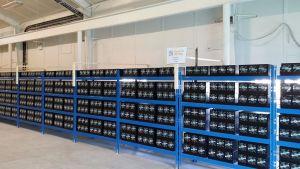
Back in the day, you could mine Bitcoin on any old PC. Mining difficulty rose over time to the point that GPUs or specialized devices known as ASICs were required to mine. Now you have a situation where whole mining farms are developed only to compete in Bitcoin mining. Mining Bitcoin is not always profitable unless you have a lot of resources and cheap energy.
To cut a long tale short, mining works as follows. Assume I ask you to predict a number between 1 and 20. Isn't it simple? We all used to play this game as kids. But suppose I ask you to pick a figure between 1 and 1 billion. A little more difficult. Now I'd want you to guess a 64-digit string of 16 symbols.
Congratulations if you guessed correctly with your hyper-giga-brain. You've 'proved the work'. This is why Proof-of-Work has been so dependable for so long and still has legitimate proof to back it up. Because of all the cryptographic work done on the network, you would require massive processing power to even remotely control or hack it. A herculean effort would be required to complete the endeavor.


0 Comments